Concerning the World and Adventures of author and scriptwriter Terry Newman and his various adventures with the written (and sung!) word in the worlds of publishing, film, theatre, television and audio. Featuring the #1 USA Kindle Epic Fantasy ***** Bestseller "Detective Strongoak and the Case of the Dead Elf" and its sequels "The King of Elfland's Little Sister" and "Dwarf Girls Don't Dance." Plus the first volume of the new series: "Camelot Noir".
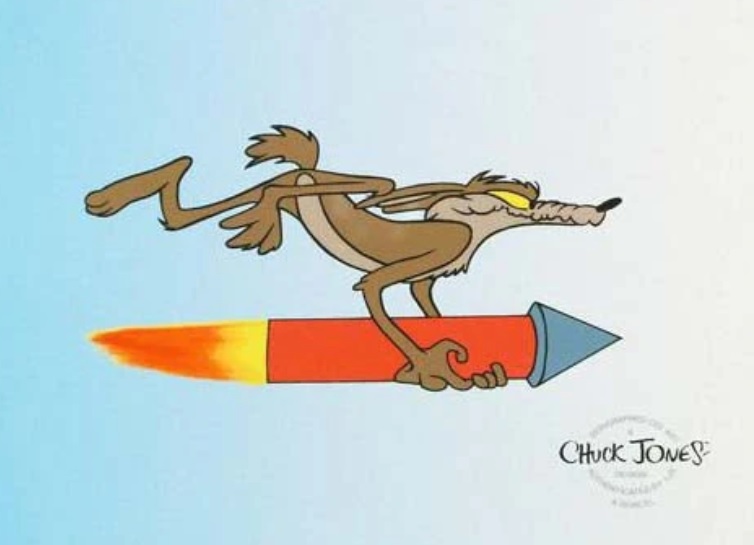
One of the great joys of my life was having the opportunity to hear a talk by the genius comedy animator and director Chuck Jones. It was in Cambridge (UK) in the 1990s when Chuck was doing a book promotion for his marvelous ‘Chuck Amuck’ autobiography.
I can safely say that I have never felt the same before or after. This was not entirely due to the awe I felt at being in the presence of somebody whose work I had adored since I first crawled eagerly to the TV set. (Family legend had it that my first word was PAL – and you have to be very old to get that!) It was also down to the fact that my mucker and fellow animation fan, Mr. Max, took that evening to introduce me to the Brain Neutralizer Cocktail*. We had two. It does what it says on the tin.
Perhaps neither of us got everything from the talk we might have. I forgot to get my copy of his book signed for a start. However, I can say that it was the first time that I had every felt like somebody from one of his cartoons: probably Wile E. Coyote after the anvil has hit his head from a great height. It was all very wonderful.
As I have mentioned, I usually only collection production cels but when I saw this signed Wile E. Coyote** sericel, with matching Roadrunner, I just had to get them. They give me a great deal of pleasure, as you can image.
Thank you for everything, Mr. Jones.
*Brain Neutralizer Cocktail We were never given the definitive recipe, but it was probably a variation on the Brain Duster. Approach with care:
1 oz. rye whiskey 1 oz. absinthe 1 oz. Italian vermouth 1 dash Angostura bitters
Stir ingredients with cracked ice. Strain into chilled glass. Go and see a hero and nearly miss it all.
This blog is supposed to be about Nicely, it says so on the tin. However, Strongoak activity has been a little lacking (Book 4 is well on the way, I promise) because the first book of a new series is soon to be published. Yes, more fantasy fun – but no dwarves!
Gasp!
More on that soon too, but in the meantime here’s a rather wonderful poster for a film I co-wrote. It won an award you know! The film is in post-production and so hopefully it will be out soon.
If you enjoy Nicely and a little fantasy, may I suggest you try some of my science fiction too. The ‘Resurrection Show’ was originally inspired by a selection of songs by the ridiculously talented David Alter. It ended up (so far) as this very funny novel: The Resurrection Show
With a cover by the inkmaster Tom Morgan-Jones this novel has been described as “Tom Sharpe style with a twist” and “Thoroughly enjoyable, funny and thought provoking.” For Nicely fans everywhere.
Yes, unbelievably, Wonder Woman is 80 today! Handy being immortal eh?
Strangely, nobody ever asked me why I wanted to write a play about a stunningly attractive Amazon Warrior Princess. I’m guessing they thought it was all to do with auditions. It wasn’t – honest. It was a newspaper article about a university lecturer who took up striptease that set me off! Things like that are always happening to me.
Yes, I had read Wonder Woman as a comic-loving boy, but not obsessively. And no, bondage subtexts never entered my pre-pubescent brain – never did Boy Scouts, never got the ‘Knots Badge’.
So what was my play: ‘Life and Times of a Wonder Woman’ all about? Well, I will let this rather lovely review from the New York Times explain:
August 26, 2004 THEATER REVIEWS | NEW YORK INTERNATIONAL FRINGE FESTIVAL She’s Oh So Wonderful and Proud of It By THE NEW YORK TIMES
‘The Life and Times of a Wonder Woman’ Puffin Room She’s superstrong, superquick, superbeautiful and supersmart with masses of jet-black hair, bright blue eyes and a body that would make a Trappist monk swear, as Wonder Woman herself tells us in this highly entertaining monologue by the English writer Terry Newman, a hit at last year’s Fringe Festival in Edinburgh. In cherry red boots, and killer bustier/hot pants outfit, the British performer Tara Hendry does the vixen superheroine justice as she relates in bawdy braggadocio Wonder Woman’s mighty Amazonian heritage, her Mount Olympus romps and more earthly pursuits, including bedding Superman (though Batman was better, she assures us). With her famous bracelets “that make short work of bullets” and her transformative twirl, Wonder Woman attempts to seduce members of the audience with her lusty tales and a magic lariat that makes it impossible for man or woman to resist the truth. This multilayered, one-hour, one-woman show is an ingenious conceit, a way of talking about feminism, sexuality and society’s view of women, told through the history of a cultural icon who went from comic book character in 1941 to hit TV star in the 1970’s played by Lynda Carter. We learn about Wonder Woman’s creator Charles Moulton, a k a William Moulton Marston. We learn that he modeled Wonder Woman on his mistress, who had masses of jet black hair, wore large sterling silver cuff bracelets and was along with himself, quietly into bondage. Part history lesson, part feminist tract, all funny, this show begins and ends with a fictitious northerner from England, Susan, who becomes captivated by the TV Wonder Woman during Saturday teatime. At the end of the show, when the audience realizes what Susan has grown up to be, they just may rue the day that they, like Susan, ever stopped believing. CAMILLE SWEENEY
So, thank you ‘Wonder Woman’ and thank you Tara Hendry nee Paulsson and director Michael Eriera and all wonderful producers Emma Douglas and Damien Scully for making one writer/fan’s dreams a reality.
I know that the whole history of, and reasons for, the UK’s ‘Guy Fawkes Night’ a.k.a. ‘Bonfire Night’ is something of a mystery to most of you guys in America. This is despite it having taken place in 1606 and hence it being part of a lot ‘your’ history too! Please excuse such a generalisation, but without it you guys wouldn’t even be guys at all!
The bare bones are that November 5th is commemorated here as the night when Guy Fawkes and his fellow conspirators were thwarted in their attempt to blow up the English parliament – with gunpowder!
Their reason?
They wanted to kill the Protestant King James and his cronies and replace him with the Princess Elizabeth – as a Catholic queen.
Every year, certainly when I grew up, Fawkes’s capture was celebrated by a big bonfire built by the children of your street (could start that in summer!), loads of fireworks, food provided by families and of course, the burning of the guy! Other people might celebrate with the family in their own back gardens.
The guy was an effigy of the Mr Fawkes made from tatty old clothes stuffed with newspaper and conkers (they go bang); plus a bought cardboard mask supposedly in the style of Mr Fawkes. Each year one would (if allowed) push, carry or ‘guy’ the effigy around asking for a ‘Penny for the Guy!’ The money to then be spent on fireworks and/or sweets (NOTE – not candy!).
This ‘Guy’ entered into literature in books such as Tom Brown at Oxford, which described someone as ‘such an old guy in his dress’. While in 1893 in ‘The Swell’s Night Guide’ they excused themselves by saying: ‘I can’t tonight, for I am going to be seduced by a rich old Guy’. This became incorporated into US English as ‘Wise Guys’ and ‘Fall Guys’, until it was just ‘you guys!’
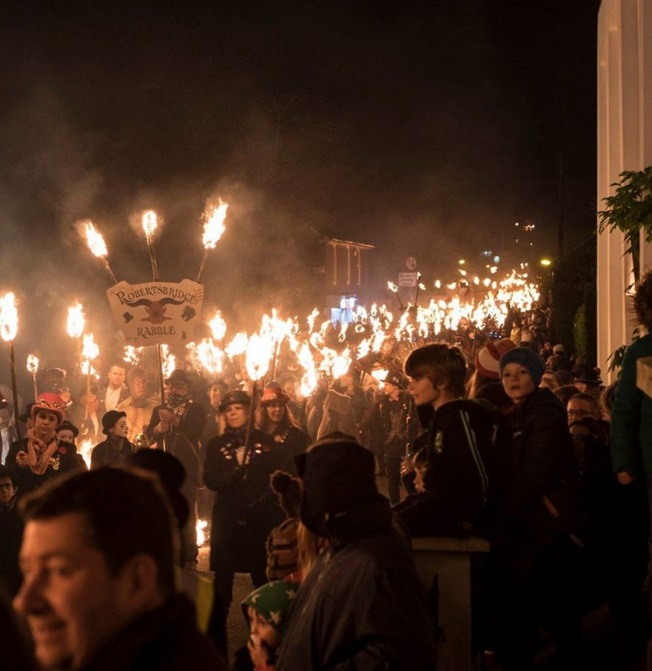
The importance of this very social (and potentially dangerous) family event has rather diminished in recent years in favour of public displays, but this depends on your location. Where I live in the south of England there is a proud tradition of Bonfire Boys (and Girls). Many villages hold a torch-lit procession through their streets with marching and drumming bonfire boys (and girls) from different villages in different fancy dress outfits. This is spread out over most of November! Each night culminated in Bonfires and fireworks and rather a lot of drinking (sadly not this year). It’s a truly splendid sight and sound: loads of drums! It’s slightly mad and it’s not state controlled!
Photo courtesy of Adrian Spinks photography
Why is this still going on?
Well, perhaps strangely, the terrorist Guy Fawkes has become something of an anarchist hero. The fact that he wanted to blow up one government to replace it by another has largely been forgotten. Every generation sees Guy Fawkes slightly differently you see. Each year we burn a different politician on our bonfire – plenty to chose from.
I have recently written the ‘book’ and some of the lyrics for a new musical about Guy Fawkes, with music by the far too talented Ben Durkin. It is actually based on a Victorian novel about the man by William Ainsworth – a Bestseller at the time! To the Victorians, Fawkes was something of a romantic figure and the novel (and the theatre show hopefully) has many gothic elements beloved by audiences of that time – spirits, alchemy and magic, and explosions of course!
And so Fawkes continues still. Those anarchist masks you see at demos, they are Guy Fawkes masks adapted from the wonderful ‘V for Vendetta’ graphic novel by Alan Moore and David Lloyd, which imagined a new ‘Guy Fawkes’ figure and a different totalitarian state. Guy Fawkes just won’t lie down!
So, you ‘guys’ over there in the USA – and everywhere else – ‘Remember, remember the 5th of November, gunpowder treason and plot. I see no reason why gunpowder treason should ever be forgot.’
Penny for the guy, mister?
Check out the amazon Susie Dent’s book ‘Word Perfect’ for more about ‘guys’ and all sorts of other fascinating words. You can read more about the exciting new musical and hear song samples at our website.
Ever since they invented computers – well, you know what I mean – I have enjoyed playing around with pictures and photos. I was lucky enough to be involved for a while in what was then called ‘interactive multi media’. I ended up demonstrating our prototype ‘Interactive Biological Information System’ to the son of a now disgraced (and dead) genuine newspaper tycoon. He said ‘I’m the guy you have to impress’. We walked away with a cheque, I guess we impressed him.
At one time we were an Apple Development Station! I had to demo what we doing to the top Apple people in the UK on a black and white monitor (that long ago). To be honest I’m not sure they really understood what we were up to as they seemed much more interested in the pictures accompanying the demo and where I had got them.
‘I drew them,’ I said.
‘What! With a mouse?’ they said.
‘Yes, it’s easy!’
‘Wow!’
I’m not sure whether we got a cheque, but we did get use of a brand new Mac!
Of course, image production and manipulation is easier than I would ever have dreamed. Here’s some fun with the new Nicely Strongoak cover – done in two minutes from a free online site. The much-younger me would have been thrilled. The older me certainly is!
Delighted to announce the cover for the new #1 Kindle Bestelling ‘Detective Strongoak’ adventure: ‘Dwarf Girls don’t Dance’. Published by Monkey Business, an imprint of Grey House in the Woods – coming soon.
“You never hear much about Dwarf women, do you? That’s because they are trouble. Real trouble.”
When Master Detective Nicely Strongoak first encounters the drop-dead gorgeous dwarfess ‘Diamond’, a fully paid up member of the Citadel Guild of Amorous Dancers and Associated Divesters, he should have known better than to leave his business card. Especially when subsequent business turns out to involve murder and the man reputed to be the Citadel’s Dark Crime Lord.
He certainly shouldn’t have gone to help Diamond beat a murder rap. Not when it involved heading back to the old Dwarf Kingdom of Skragsrealm, and the memories of a much younger Nicely and his encounter with the Nine Idlers – a group of men, elves, gnomes, dwarves and even a Warrior Princess. Oh, and the one brutal killing he had never managed to solve. Yet his alliance with the strangely attractive gobliness Detective Analyst Grundrund leads Nicely on a trail full of enchanters and lost love that might solve not just one, but three murders. That’s if the rewilded wolves and mud dragons don’t get him first.
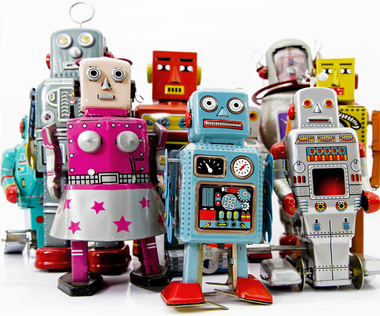
I have always been a huge fan of robots. I adored ‘Robbie’ in Lost in Space – although I preferred him in ‘Forbidden Planet’.
Gort was great too!
He was the eight-foot robot companion of the alien Klaatu in 1958’s classic ‘The Day the Earth Stood Still’. Unfortunately he lacked facial features, but was still capable of more expression than Keanu Reeve who played Klaatu in the remake. And Gort could open his visor and shoot out a death-beam, something else Keanu Reeve can’t do – yet.
Then there is Marvin – ah, Marvin! ‘Brain the size of a planet’, but he’s an android isn’t he?
And of course everybody loves Asimo, the real-life walking and running robot from Honda, who unfortunately stands a little like he might have had a minor oil leak in his metal shorts. Apparently it is a complete coincidence that his name sounds like Asimov, the surname of the SF writer who proposed the three laws of robotics. These are (and surely it’s not just us cool guys who know this?) the following:
1.A robot may not injure a human being or, through inaction, allow a human being to come to harm.
2.A robot must obey the orders given to it by human beings, except where such orders would conflict with the First Law.
3.A robot must protect its own existence as long as such protection does not conflict with the First or Second Laws.
Not bad thinking for 1942 Mr Asimov!
I think we can safely say that these laws should apply to androids too – especially Marvin.
Anyway – robots everywhere: happy birthday! You are 100 years old this year! Many congratulations!
It was in 1920 that Czech Karel Čapek published R.U.R., which stands for Rossumovi Univerzální Roboti (Rossum’s Universal Robots). The play wasn’t actually performed until 1921, but it was from his play that the word ‘robot’ soon entered human language. It is now used to define any a machine that is programmed to move and perform certain tasks automatically.
However it is clear from this early photograph from a production of R.U.R. that they were intended to be human-like. In that, they were actually very much like androids – a term that appears in US patents as early as 1863 and, as “Androides” in Ephraim Chambers’ Cyclopaedia of 1728.
Since then robots, and androids – and cyborgs too (a name first coined in 1960 by Manfred Clynes and Nathan S. Kline) – have given us plenty to think about when it comes to being human.










 Here be a blog for Terry Newman and Master Detective Nicely Strongoak