A short introduction to the ‘Reveries of Yore’ called ‘The Well of Unhappiness‘. It may be short but it is strange!

A short introduction to the ‘Reveries of Yore’ called ‘The Well of Unhappiness‘. It may be short but it is strange!

Absolutely delighted to share something new I have been contributing to called Reveries of Yore: https://www.youtube.com/watch?v=V-fzOYr5md8 . It’s a fantasy series set in a fascinating world that is defined by mysterious wicketgates and the lore and adventures will grow as different authors contribute. With various story lengths it’s perfect for late night listening or journeys both short and long. I hope you all enjoy it!
I have been made aware that it might be a good idea to mention that this isn’t for children — not that it’s particularly rude or anything, just not children’s fantasy. It is rather lovely though, so pleased to hear it read aloud.
Congratulations to Aaron whose baby this is and thanks to Laura Greaves for the marvellous narration.

I love myths. I have for as long as I can remember. Myths are traditional stories, especially ones that are concerning with the early history of specific groups of people and give insights into natural or social phenomenon. This can often involve supernatural beings or events, which is pretty much fantasy too. Myths from different locations share a lot of things in common, across the miles and the years – as does crime, but we’ll get to that.
The tales about King Arthur and his Round Table are based in myth and legend too – the difference between that legends potentially have an historical basis. If any story has been more continuously reinvented, from the days of Thomas Mallory’s Le Morte d’Arthur to teen-appeal TV, I don’t know of it. Mark Twain even put ‘A Connecticut Yankee in King Arthur’s Court’
So, I wondered, some time ago now, whether Camelot was ripe for yet another reinvention? A reinvention that involved a little more crime, that in essence was a touch more Noir? ‘Camelot Noir’ – it certainly has a ring to it!
I realised straight off that this was not the sort of book to appeal to genre purists of course, let alone those who think that intertextuality should be banned and books, movies, plays, songs and games must all stay in their separate boxes. I don’t. I worship at the altar of intertextuality, nothing excites me more – witness my not getting to sleep when I discovered something exciting about the fabulous ‘Pennyworth’ TV series last night (but that’s another blog!). And these classifications are breaking down all over the place and, as a film scriptwriter as well, I love playing with genres: crime and fantasy, myths and murder – well it went on all the time, didn’t it?
There is one major question to be answered though; are the basics necessary for crime fiction present in such a myth? It’s a very important question as well. Fortunately I had some help in answering it. Crime writer, and former police officer, Clare Mackintosh has put together a 10-point checklist that or us to cover the subject matter.
Here are what Clare suggests are the essentials of crime fiction and what I believe ‘Camelot Noir’ offers.
A hook
Well, how about being in Camelot without a single shiny knight in sight? Just those ‘mean cobbled streets’ that detectives have always strode down in one guise or another.
Atmosphere.
Camelot would certainly be dark and mysterious enough for a good Noir feel. Camelot could have invented it.
A crime.
The place is lousy with swords, surely a serious crime is almost inevitable. Yes, but the crime has to matter – it can’t be just casual mayhem. That wouldn’t do at all, although such violence can’t be ruled out either.
A victim.
The victim therefore needs to matter – as Lords and Ladies always have done.
A villain.
Oh, myths have plenty of great villains. Camelot is no exception, take your pick.
Red herrings.
When there is a fantasy element the herrings aren’t just red they can fly too. No cheating though, a common problem for ‘detectives’ in science fiction crime novels as well.
Twists and reveals.
How about throwing in an ageless magician with his own agenda? That should do it.
Tension.
The fate of an entire Kingdom and the monarchy should create enough of that.
A satisfying Resolution
With room for a sequel? No problem.
A hero
There are plenty of heroes in Camelot. Rather too many perhaps and they all wear a lot of polished metal and sit round a big Round Table. They’re great in their place but not the right sort of hero we need at all. No, what Camelot needs, to quote Raymond Chandler is a man “who is neither tarnished nor afraid. He is the hero; he is everything. He must be a complete man and a common man and yet an unusual man… He must be the best man in his world and a good enough man for any world. He will take no man’s money dishonestly and no man’s insolence without a due and dispassionate revenge.’ Perhaps he could be called Chaucere? (The extra ‘e’ being a nod Chandler’s Marlowe – see what I did?)
That’s the 10 essential ingredients for crime fiction all ticked then and so I hereby conclude that this Arthurian myth, at least, fulfils the bill.
All that remains is for me to introduce you to our hero Chaucere. A man with a great sense of fair play for all people, not just those in the Big House on the Hill. A sword that was ‘for hire’ for many years in many different places, before our man’s feet led him back to the place of his birth and a secret he dare not reveal, less a Kingdom falls before it rises. He lives in the less elegant environs of a Camelot you won’t have seen before. This, after all, is ‘Camelot Noir’.
It’s just a crime novel really, with magicians, a well-known King and a famous sword. It’s published by Monkey Business, an imprint of Grey House in the Woods.
Reference
10 essential ingredients for crime fiction by Clare Mackintosh

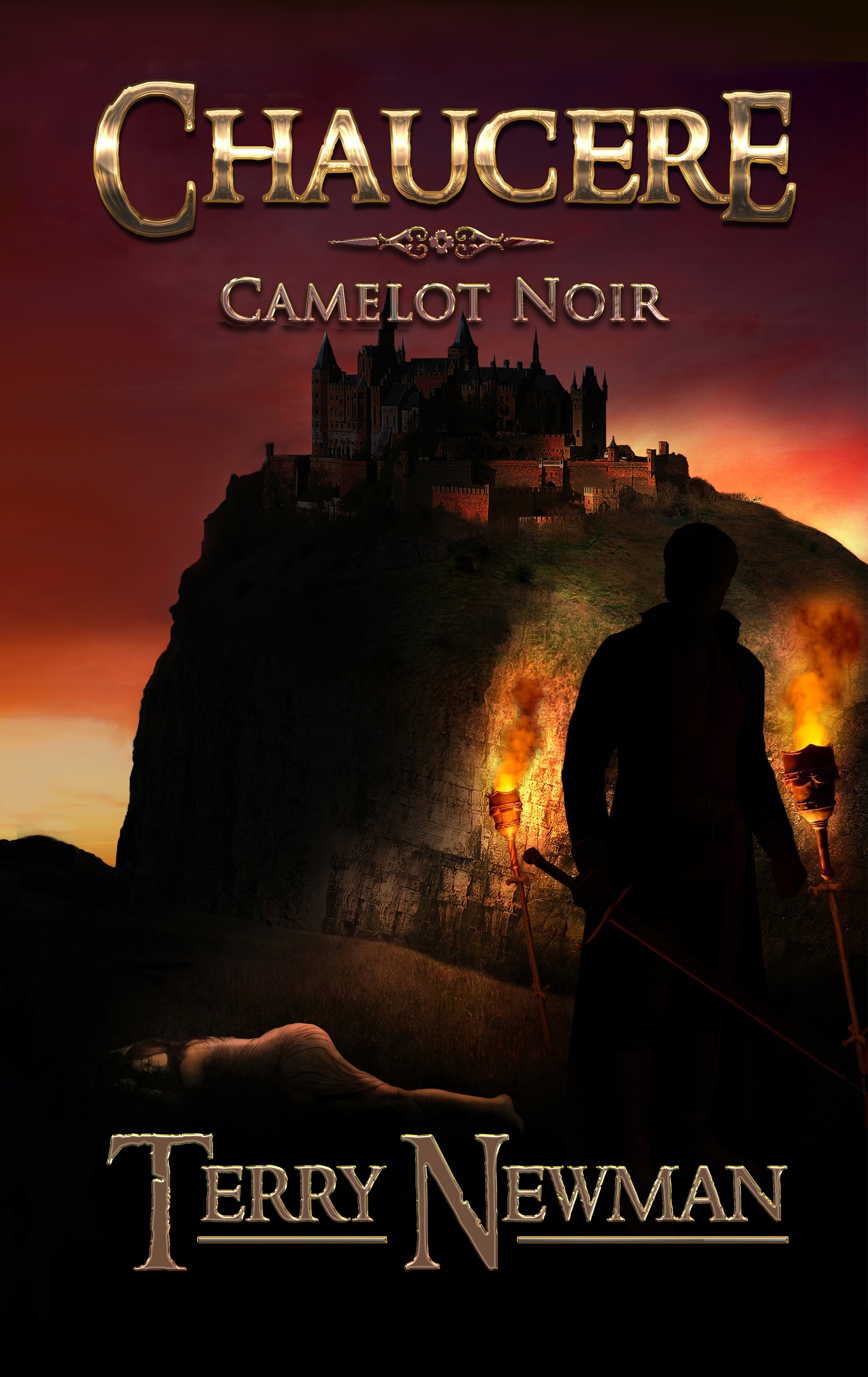
Here is the new novel. No, it’s not a ‘Detective Nicely Strongoak’ adventure, but a brand new series that goes under the heading of ‘Camelot Noir’.
I am very happy about it.


It’s in the can and heading to postproduction! More news soon!

Ever since they invented computers – well, you know what I mean – I have enjoyed playing around with pictures and photos. I was lucky enough to be involved for a while in what was then called ‘interactive multi media’. I ended up demonstrating our prototype ‘Interactive Biological Information System’ to the son of a now disgraced (and dead) genuine newspaper tycoon. He said ‘I’m the guy you have to impress’. We walked away with a cheque, I guess we impressed him.
At one time we were an Apple Development Station! I had to demo what we doing to the top Apple people in the UK on a black and white monitor (that long ago). To be honest I’m not sure they really understood what we were up to as they seemed much more interested in the pictures accompanying the demo and where I had got them.
‘I drew them,’ I said.
‘What! With a mouse?’ they said.
‘Yes, it’s easy!’
‘Wow!’
I’m not sure whether we got a cheque, but we did get use of a brand new Mac!
Of course, image production and manipulation is easier than I would ever have dreamed. Here’s some fun with the new Nicely Strongoak cover – done in two minutes from a free online site. The much-younger me would have been thrilled. The older me certainly is!

Always nice to hear Nicely’s theme song:
Published September 18th by Monkey House
Continue reading Dwarf Girls – the movie

Being asked to appear at a Literary Festival, especially a local one, is always a great honour. At the behest of my inspired interviewer Isabel Lloyd I delivered a ‘Magnificent 7’ of the fictional characters I love who have also inspired my writing. Here are some more words about these fabulous characters, who have meant so much to me.

Samwise Gamgee
There has to be some Tolkien of course. If it wasn’t for Tolkien I would never have wondered what did happen in Middle Earth when everything moved on a few thousand years, and they had an industrial revolution, and race relations and such like became important, and they even needed a dwarf detective in the first place.
But why Samwise, after all isn’t Frodo the main character of LOTR? Or maybe Aragorn, the proper heroic type? No, actually it’s Sam who is the protagonist of the book, because a protagonist is defined by change. Frodo and Aragorn are certainly heroes – but they don’t really change. Sam, bless him, goes off on his adventuring dreaming of the heroes of old, and to his amazement becomes one of those heroes.
He is the everyman and we need everymen and everywomen:
“That there’s some good in this world, Mr. Frodo… and it’s worth fighting for.”
Philip Marlowe
Raymond Chandler introduced the mostly science fiction and fantasy reading me to a whole new world, that of crime. Some say Dashiell Hammett did crime better, but Chandler did it with more class. The world-weary knight in tarnished armour, treading those ‘mean streets’ was the main inspiration for my own dwarf detective Nicely Strongoak walking his ‘mean cobbled street’. Chandler also taught me that books weren’t just about storytelling – my main passion until then – but about the language to. And what language!
‘She had the kind of figure that would make a Bishop kick a hole in a stained glass window’.
I also loved the things I didn’t even recognise: ‘Chesterfields’ and ‘Davenports’ and the ephemera of a bygone age – which it was by then for me.
And if the past is a foreign country – why not make a few things up and put them in your books too! I know I did.
Arthur Dent
Douglas Adams – who I singularly failed to meet one day in the 1980s, but I got a nice pen from Apple – was a hero. His radio series of ‘The Hitchhiker’s Guide to the Universe’ was a huge inspiration and was responsible for the first version of Nicely being written for audio. Bit of a mistake that, looking back, as it took me twenty five years to get it into novel form as the Radio 4 producer suggested to me. Arthur Dent appeals to that part of all of us that never feels like it is completely in control of events. Even detectives are never completely in control, which is why they get hit a lot.
‘This must be Thursday. I could never get the hang of Thursdays.’
DEATH
And so we come to Terry Pratchett’s DEATH. This is not Terry Pratchett’s personal death – which sadly came far too early, but his character DEATH. Finding a favourite character from Terry Pratchett was actually quite difficult. He’s not really about the characters for me, although there are many great ones, like Rincewind, Nanny Ogg and The Luggage, but he’s more about attitude – a way of looking at things. I was pretty upset when Mr Pratchett made it into print before I did – by the odd twenty five years or so – because he did so well what I originally set out to do. He deconstructed fantasy ideas and used them to address many of the foibles of – well, ‘life the universe and everything’. Thanks to Mr Pratchett I had to tighten my focus and make sure that my books became proper crime books too. There had always been a murder or two and a mystery, but now that was really something to be solved. Nicely grew up a bit and became more of his own dwarf. DEATH stands out, because he TALKS IN CAPITALS and because he is really quite a decent chap. You wouldn’t mind having a drink with DEATH, as long as his bitter didn’t go everywhere.
Two death quotes:
“And what would humans be without love?”
“RARE, said Death.”
and given the subject matter, this one:
HUMANS NEED FANTASY TO BE HUMAN. TO BE THE PLACE WHERE THE FALLING ANGEL MEETS THE RISING APE.
Howard the Duck
Iron Man is really so much scrap, Superman couldn’t have a sex life, Batman can’t talk properly, which makes Howard the Duck the greatest comic book ever, and one of the great film turkeys too. Certainly the worse crime against cinema committed by George Lucas.
Howard the Duck is a cynical, tough-talking, cigar champing duck, who ends up in a world of hairless apes. It wasn’t just the fish out of water aspect that appealed to me, but also that he was able to satirise and basically ‘take the piss’ out of all the Marvel comic book heroes, as well as other cultural norms, while still going along with their fun and games. An attitude I approve of and exploited in my 2005 play: ‘What do you do on the Night after you’ve Saved the Universe?’ This was a play that basically featured super-heroes sitting round and eating pizza. Had great fun with ‘C Thru Girl’ and ‘Minuscule Man’.
The great affection felt for Howard in the comic book community can be seen by the fact that he has a cameo in both ‘Guardians of the Galaxy’ films.
“Hey, if I had some place to go I certainly wouldn’t be in Cleveland” – insert your least loved location.
Harry Dresden
A detective and a wizard – isn’t that a little close to comfort, Terry?
No actually – Jim Bishop’s modern day Chicago based PI shows how much fun you can have with the tropes and ideas of fantasy in a modern setting – yet be very different. This was a great relief to me when I was trying to get ‘Nicely’ published. A very different cauldron of spells.
For a start, being a wizard, Jim actually uses magic. Nicely Strongoak isn’t too sure about magic. He prefers his racing green, ’57 Dragonette convertible steam wagon, the model with the air trims and the longer foils, and a shooter instead of a staff. Nicely wears good hats. Harry doesn’t wear a hat – whatever the covers may show!
Bernie Gunther
The late Philip Kerr’s WWII German detective Bernie Gunther is one of the great creations. He narrowly beat another German, Gunther Grass’s ‘Oskar Matzerath’ to my list. Like Oskar, Bernie Gunther holds up a powerful light to shine on the atrocities of WWII and the circumstances that make an essentially decent policeman do what he has to, and makes us wonder what we might do in similar circumstances.
And in Berlin of the war period Kerr also provides another world with its own furniture and slang as interesting and varied as any fantasy world can be.
Bernie quotes:
“When you get a cat to catch the mice in your kitchen, you can’t expect it to ignore the rats in the cellar.”
and:
“Looking round the room I found there were so many false eyelashes flapping at me that I was beginning to feel a draught.”
Please note: I could have cheated for the sake of political correctness and included references to private investigators ‘Kinsey Malone’, and ‘VI Paretsky’ – who I love – or female action heroes like Ellen Ripley and Sarah Connor – but they are mostly film and this was for a literary festival after all. And I haven’t mentioned ‘intertextuality’ at all! At the end of the day it’s all about what influenced my writing the most and these are the main people, outside of Roxy Music, David Bowie, August Darnell and Bugs Bunny.
That’s all folks!
* With thanks to Jane Triton and The Robertsbridge Arts Partnership and, of course, my intrepid interviewer, the writer and journalist, Isabel Lloyd.
Continue reading Dr Tel’s Magnificent Seven

In the days before streaming, MP3s and such like – when proper music came in vinyl that they called ‘long players’, there was something called ‘Difficult Second Album Syndrome’.
An album was another name for a LP (long player), being a number of audio recordings issued as a collection, which after vinyl’s heyday was then also used for both tape cassettes and CD collections – gosh, it’s like a history lesson!
And the ‘difficult second album’ was what they called the follow-up LP a band or singer had to bring out pretty quickly after the initial success of their debut. Usually with the record label pushing them hard! The problem referenced the fact that recording artistes had, apparently, often used up all their best ideas on that impressive first record.
Now, novels having been around a lot longer than LPs (did any classical music composers have ‘that difficult second symphony syndrome’?) you would think more would have been written about ‘Second Novel Syndrome’. Of course it must exist, after all Margaret Mitchell never managed another book after ‘Gone with the Wind’. J D Salinger rather dried up after ‘Catcher in the Rye’. Maybe it’s more success related than the actual writing?

What then can be done to get over this problem? And did I ever suffer from ‘Difficult Second Novel Syndrome’ when writing ‘The King of Elfland’s Little Sister’ (KELS)? This being the second adventure of the ‘#1 Kindle Bestselling’ Master Detective Nicely Strongoak. (Not exactly ‘Gone With The Wind’ or ‘Catcher in the Rye’ fame I know!)
The answer is no. And not because I’d already published ‘The Resolution Show’ with David Alter in between, because chronologically that was actually written a lot later.
The explanation, and the way to get round ‘Difficult Second Novel Syndrome’, is to start the second novel before you finish the first! Well, that’s what I did with KELS.
What’s this all about then? Simply put, when writing Nicely’s first adventure ‘Detective Strongoak and the Case of the Dead Elf’ I found that there was a lot of material being generated that just didn’t fit in that first book. It was either connected to events, or characters, which just didn’t belong in ‘A Dead Elf’. They were too good to waste though and I put them elsewhere (in my fester box) and gradually KELS began to take shape there.
Bottom line, I had half of this book finished before I had completed Nicely’s first adventure. This meant I had none of that ‘blank page’ problem when it came to writing KELS for real. There were a lot of other problems of course, but not to do with the actual writing.
And, guess what?
While I was getting the rest of KELS together the elements of Book 3 of Nicely’s adventures were taking shape. Now, on ‘The King of Elfland’s Little Sister’ publication day, I am delighted to announce that the first draft of Book 3 is also complete. It’s called …
Sorry, you’ll have to wait for that treat, but in putting that book together the basis for Book 4 began to take shape as well. But that, as they say, is another story.
Continue reading That Difficult Second Album


 Here be a blog for Terry Newman and Master Detective Nicely Strongoak